
If photonics delivers everything it promised for AI, could it produce a monopoly more concentrated than Standard Oil?
Data-centre cost savings push us away from copper towards photonics in this simulation.

TLDR
Question: If photonics delivers everything it promised on efficiency and cost, why did the transition produce a monopoly more concentrated than Standard Oil?
Day 1: Three independent journalists triangulated 25-35% TCO savings from hyperscaler engineers running live tests, while the only two MOCVD reactor makers in the world are already running a fourteen-month backlog.
Year 1: At 412 FIT against a 100 FIT qualification threshold, co-packaged optics fails hyperscaler reliability requirements four times over, while both qualified InP wafer fabs globally are already fully booked.
Year 5: A 70% per-port power reduction failed to cut aggregate grid demand because efficiency gains immediately enabled denser racks, larger models, and forty-seven gigawatts of new US gas-peaker permits in eighteen months.
Year 10: Export controls that blocked China from MOCVD reactors produced an InP supply structure where Japan holds sixty-one percent and the US holds just fourteen, a strategic outcome encoded in the market-share data.
Year 25: transition produced a hardware monopoly more concentrated than Standard Oil’s, hiding inside a national-security classification that has been renewed six times without a single public hearing
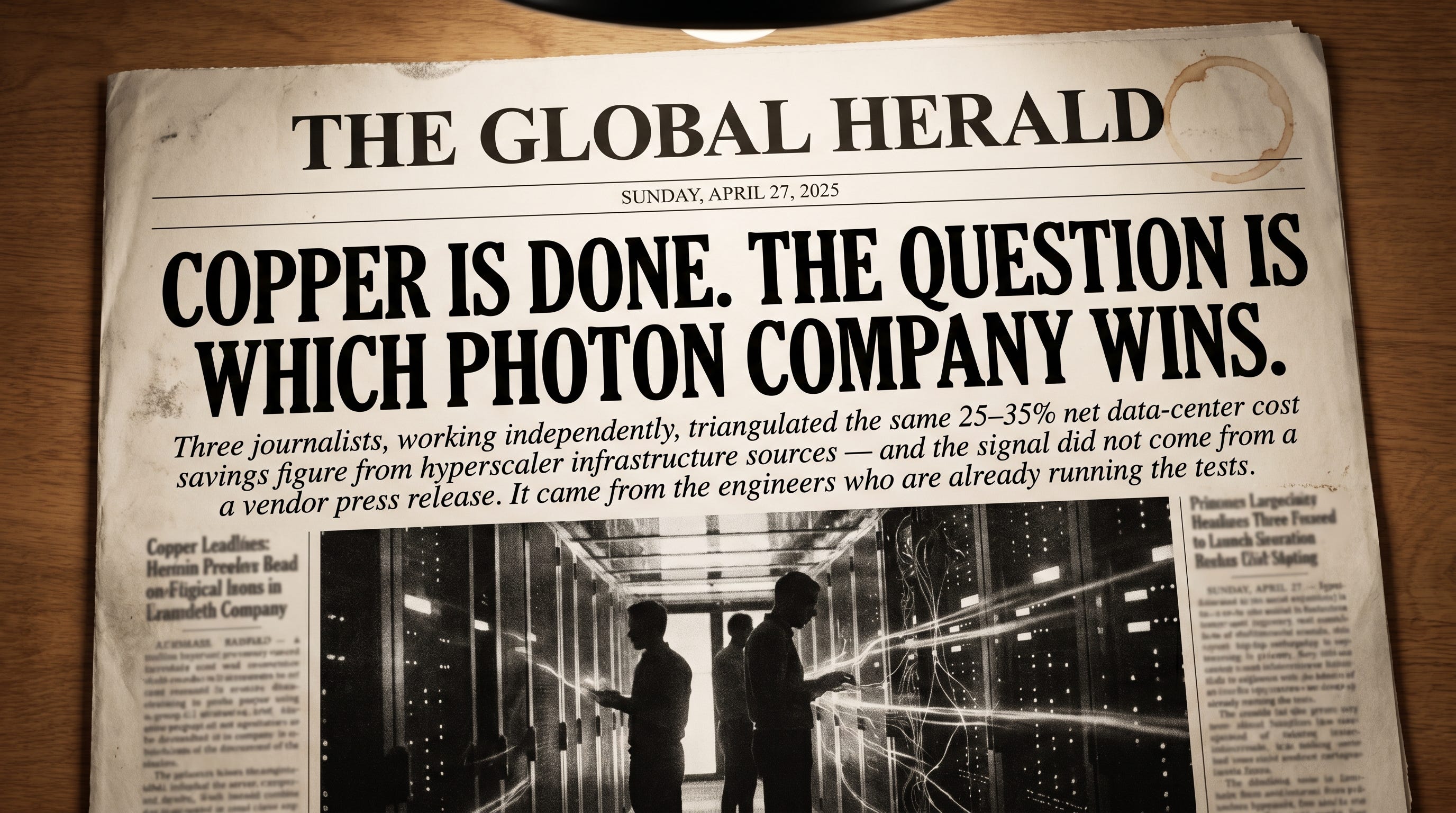
COPPER IS DONE. THE QUESTION IS WHICH PHOTON COMPANY WINS.
Inspired By
This episode is based on "The Photonics Era Is Coming", published on PhotonEra (Substack).
PhotonEra argues copper interconnects have reached their physical limits inside AI data centers: 0.5 dB signal loss per centimeter at 56 GHz, 15-17 watts per port versus photonics at 4-5 watts, failing beyond 20-50 cm on server boards. As Meta, Microsoft, Google, and Amazon collectively planned $300B+ AI infrastructure in 2025, companies including Ayar Labs, Lightmatter, Intel, Marvell, and Broadcom are pushing silicon photonics, co-packaged optics, and lithium niobate modulators toward commercial deployment — wavelength division multiplexing enabling multiple simultaneous data streams through a single fiber, impossible with copper.
We ran this thesis through our multi-agent simulation to explore what happens when the numbers play out across five time horizons.
How This Simulation Works
Ask NOSTRA runs a multi-agent swarm simulation to model the cascade effects of speculative scenarios. This is not prediction — it is a structured exploration of possibility space, built on real-world constraints and emergent agent behaviour.
The question asked of the simulation
PhotonEra argues that copper interconnects have reached their physical limits inside AI data centers — experiencing 0.5 decibels of signal loss per centimeter at 56 gigahertz, consuming 15 to 17 watts per port versus photonics at 4 to 5 watts, and failing catastrophically beyond 20 to 50 centimeters on server boards — as Meta, Microsoft, Google, and Amazon collectively planned over 300 billion dollars in AI infrastructure spending in 2025, and companies including Ayar Labs, Lightmatter, Intel, Marvell, and Broadcom are pushing silicon photonics, co-packaged optics, and lithium niobate modulators toward commercial deployment; what happens to the global AI computing infrastructure, the semiconductor industry, the geopolitics of AI capability, energy consumption at the grid level, and the companies and nations positioned in the optical supply chain if photonic interconnects replace copper inside the world's AI clusters over the next twenty-five years?
Swarm Architecture
24 independent AI agents, each with a distinct social role,
behavioural profile, biases, and information access20 rounds of inter-agent discourse per time period — agents read,
react, update beliefs, and publish new outputs5 time horizons: Day 1 → Year 1 → Year 5 → Year 10 → Year 25
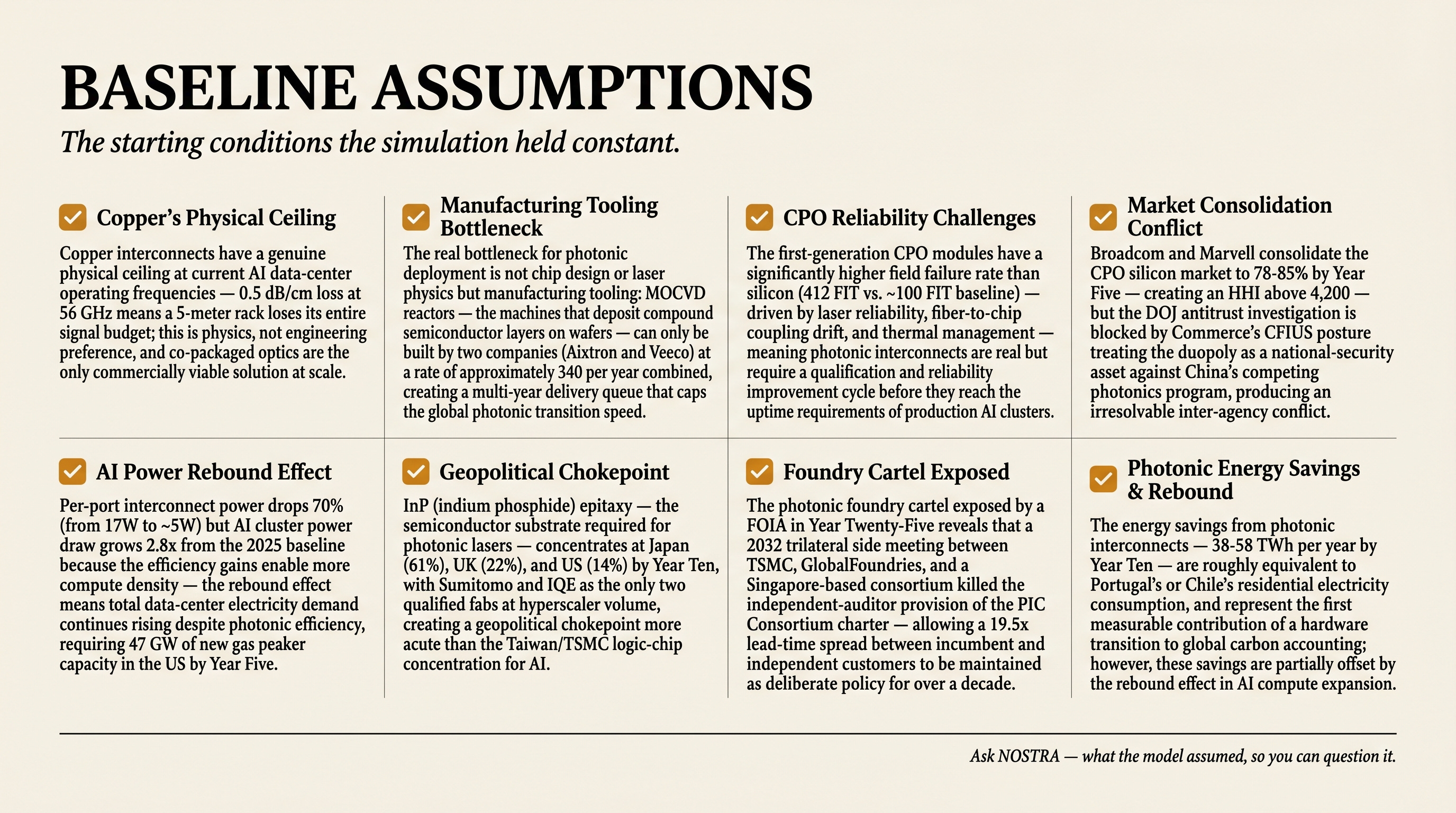
The simulation began with these conditions as its starting state:
Copper interconnects have a genuine physical ceiling at current AI data-center operating frequencies — 0.5 dB/cm loss at 56 GHz means a 5-meter rack loses its entire signal budget; this is physics, not engineering preference, and co-packaged optics are the only commercially viable solution at scale.
The real bottleneck for photonic deployment is not chip design or laser physics but manufacturing tooling: MOCVD reactors — the machines that deposit compound semiconductor layers on wafers — can only be built by two companies (Aixtron and Veeco) at a rate of approximately 340 per year combined, creating a multi-year delivery queue that caps the global photonic transition speed.
The first-generation CPO modules have a significantly higher field failure rate than silicon (412 FIT vs. ~100 FIT baseline) — driven by laser reliability, fiber-to-chip coupling drift, and thermal management — meaning photonic interconnects are real but require a qualification and reliability improvement cycle before they reach the uptime requirements of production AI clusters.
Broadcom and Marvell consolidate the CPO silicon market to 78-85% by Year Five — creating an HHI above 4,200 — but the DOJ antitrust investigation is blocked by Commerce's CFIUS posture treating the duopoly as a national-security asset against China's competing photonics program, producing an irresolvable inter-agency conflict.
Per-port interconnect power drops 70% (from 17W to ~5W) but AI cluster power draw grows 2.8x from the 2025 baseline because the efficiency gains enable more compute density — the rebound effect means total data-center electricity demand continues rising despite photonic efficiency, requiring 47 GW of new gas peaker capacity in the US by Year Five.
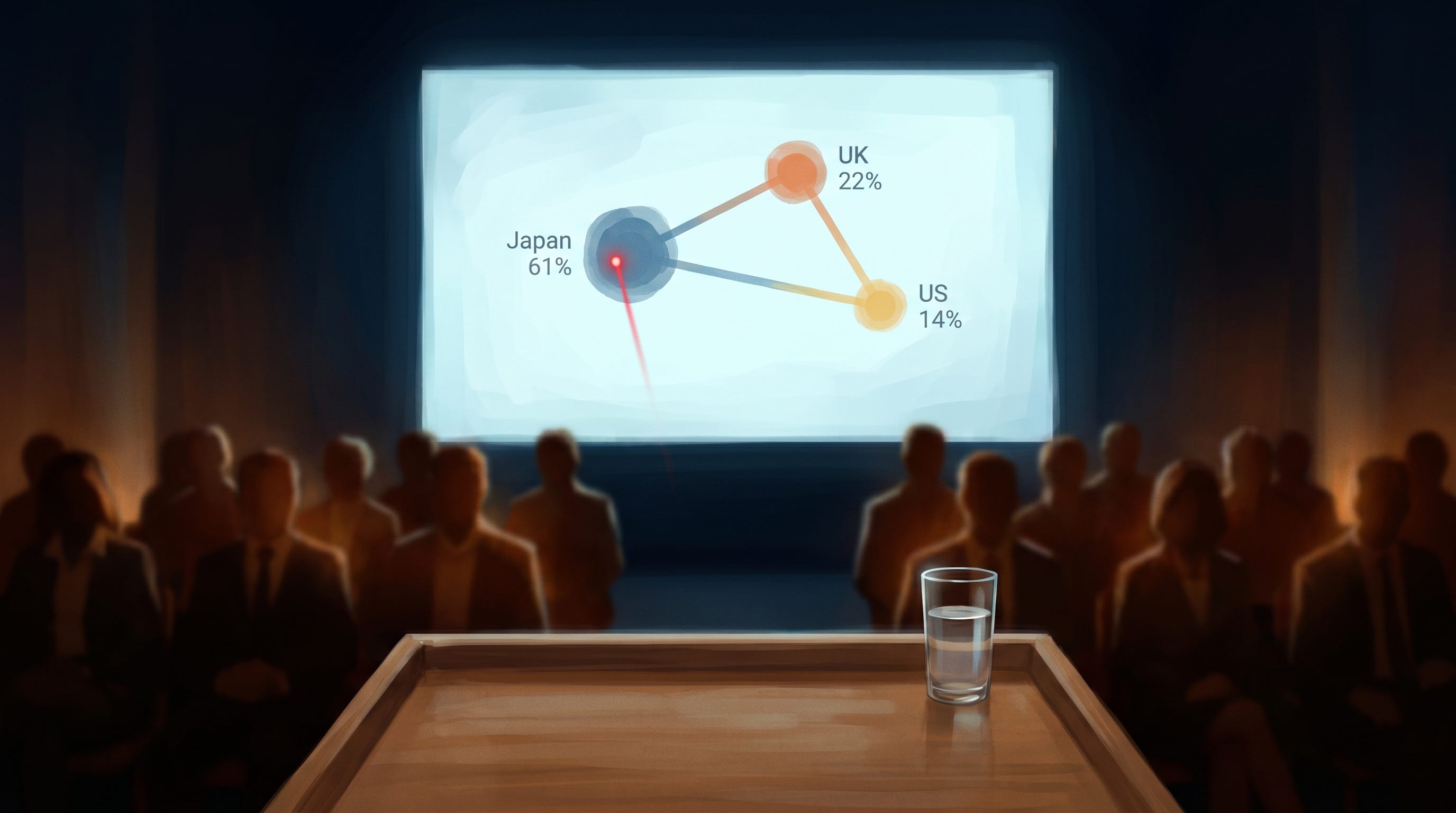
InP (indium phosphide) epitaxy — the semiconductor substrate required for photonic lasers — concentrates at Japan (61%), UK (22%), and US (14%) by Year Ten, with Sumitomo and IQE as the only two qualified fabs at hyperscaler volume, creating a geopolitical chokepoint more acute than the Taiwan/TSMC logic-chip concentration for AI.
The photonic foundry cartel exposed by a FOIA in Year Twenty-Five reveals that a 2032 trilateral side meeting between TSMC, GlobalFoundries, and a Singapore-based consortium killed the independent-auditor provision of the PIC Consortium charter — allowing a 19.5x lead-time spread between incumbent and independent customers to be maintained as deliberate policy for over a decade.
The energy savings from photonic interconnects — 38-58 TWh per year by Year Ten — are roughly equivalent to Portugal's or Chile's residential electricity consumption, and represent the first measurable contribution of a hardware transition to global carbon accounting; however, these savings are partially offset by the rebound effect in AI compute expansion.
The Narrator

Dr. Kenji Tanaka · age 44 · Associate Professor of Electrical Engineering at UC Davis; host of 'The Signal Path' podcast about hardware, semiconductors, and the physics of computing · Davis, California
Everything that follows is one person's record of what they saw, heard, and were told. The institution is rendered through their proximity to it, not from above it.
Welcome to a special five-episode series on The Signal Path. I'm Kenji Tanaka. This show is usually one episode about one hardware problem: a chip architecture, a memory bottleneck, a cooling constraint. This series is five episodes about one hardware transition, tracked across twenty-five years.
The transition is this: copper wires are physically unable to carry the data volumes that AI data centers now require at the distances they require them. This is not an engineering opinion. It is a consequence of the skin effect and signal attenuation, which are properties of electromagnetism that do not negotiate. The solution is photonic interconnects — sending data as light rather than electrons — and the companies building them (Ayar Labs, Lightmatter, Broadcom, Marvell, Intel, and others) are in a race to qualify, manufacture, and deploy co-packaged optics at a scale that the $300-billion AI infrastructure buildout of 2025 is demanding right now, not in a decade.
We ran a simulation. Twenty-four invented agents — hardware engineers, supply-chain analysts, geopolitical strategists, data-center operators, chip investors, and the equipment manufacturers who actually build the machines that make the chips — debating ten rounds across five time periods. The central finding surprised me, and I work in this field. The binding constraint on the photonic transition was not the physics. It was not the lasers. It was not the wafers. It was a machine-tool company in a town called Herzogenrath in western Germany.
My partner Lena runs data-center operations for a major hyperscaler in Oregon. My former student Diego is a photonic integration engineer at a startup in Santa Clara. My brother Jun sells copper cable in Osaka and watches his order book with the attention of a man who knows which way the wind is blowing. They are going to appear across these five episodes as the ground truth beneath the data-center capital-expenditure reports. The events described are simulated projections. The physics is not simulated.
Day 1
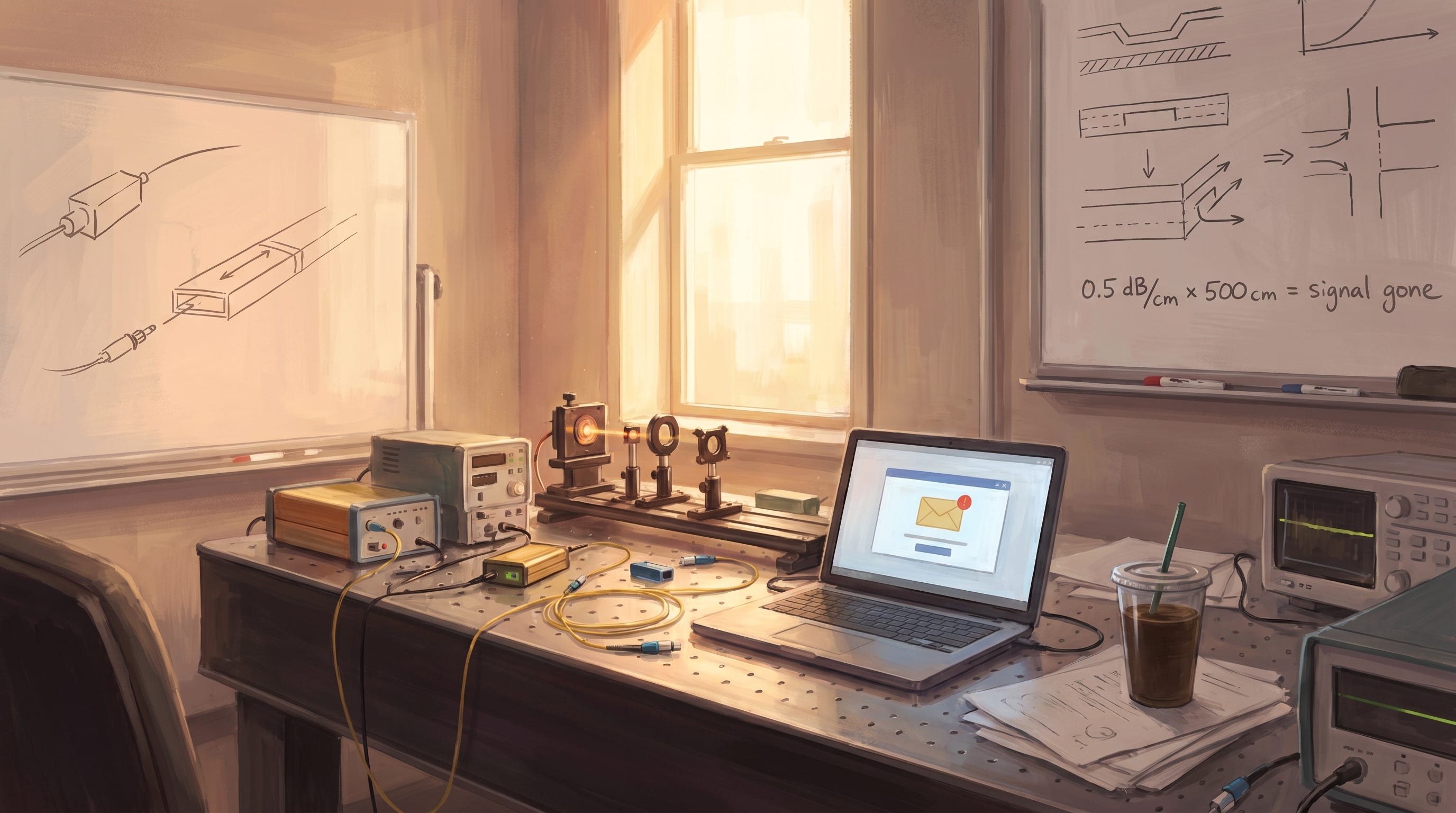
Day 1 — simulation snapshot
[present, grounded — field report register] I'm recording this from the photonic devices lab here at UC Davis. It's Sunday afternoon and I've been here since six this morning because Diego — my former student, now at Ayar Labs in Santa Clara — sent me a message at midnight with three words: qual samples shipped. I want to tell you what that means and why I drove to campus on a Sunday.
Co-packaged optics, or CPO: the technique of mounting the photonic transmitter and receiver directly on the same package as the computing chip, eliminating the copper traces between them. This is different from the pluggable optical modules you've seen in data-center photos — those are optical at the fiber level but still copper at the chip level. CPO goes all the way to the silicon. The advantage: light travels through glass fiber with a loss of 0.17 decibels per kilometer. Copper loses 0.5 decibels per centimeter at the frequencies we're now running. A rack is five meters wide. At 56 gigahertz, your copper signal is gone before it crosses the room.
Three journalists published a convergent story this week. Working separately, from different hyperscaler infrastructure sources, they confirmed the same number: twenty-five to thirty-five percent net total-cost-of-ownership savings on co-packaged-optics deployments, relative to the current best copper-plus-pluggable-optical baseline. That number came not from a vendor press release but from the engineers running the bring-up tests at Microsoft and Meta simultaneously. Lena — my partner, who runs data-center ops for one of the other major hyperscalers — confirmed to me that their internal numbers are in the same range. She cannot say that on the record. Three journalists can, because they found the same sources independently. The triangulation is the confirmation.
I want to give you a physical intuition for why this matters beyond the cost math. The current best server-class optical transceivers run at seventeen watts per port. The photonic equivalent runs at four to five watts. In a hyperscale data center running a hundred thousand GPU ports, that is a one-point-two-gigawatt facility versus a three-hundred-and-fifty-megawatt facility — a difference of roughly eight hundred and fifty megawatts, which is more than the entire electrical capacity of some US states. Lena manages the cooling for a facility that has been running sixteen-hour thermal-management shifts for the past eight months. The numbers she is looking at in the CPO qualification data are not abstract.
Diego shipped twelve qualification modules on Thursday. They are at the hyperscaler facility tonight. The test results will come back in approximately three weeks. He has been working on these for two years. The chips are smaller than a thumbnail and cost more to produce, right now, than a mid-range car. By the time they are in production at scale — if the qualification passes and the wafer fabs can keep up, which is the question I am going to spend the next four episodes answering — they will cost less than the copper they replace.
Around the world this Sunday: in Herzogenrath, Germany, a company called Aixtron is running a fourteen-month backlog on the MOCVD reactors that deposit the compound semiconductor layers required for photonic lasers. MOCVD: metal-organic chemical vapor deposition. It is the machine that grows the crystal. Without that machine, there is no photonic chip. The backlog exists because every photonic company in the world needs the same machine and Aixtron and one competitor named Veeco are the only two companies that build it. My brother Jun, in Osaka, is watching this from the copper side. He told me last week that his company's forward order book looks fine through the next eighteen months, which is exactly the horizon that hyperscalers are running their current hardware generation on. After that, he said, he does not know. That is the honest answer. I will see you in episode two.
Keep your signal clean.
Year 1
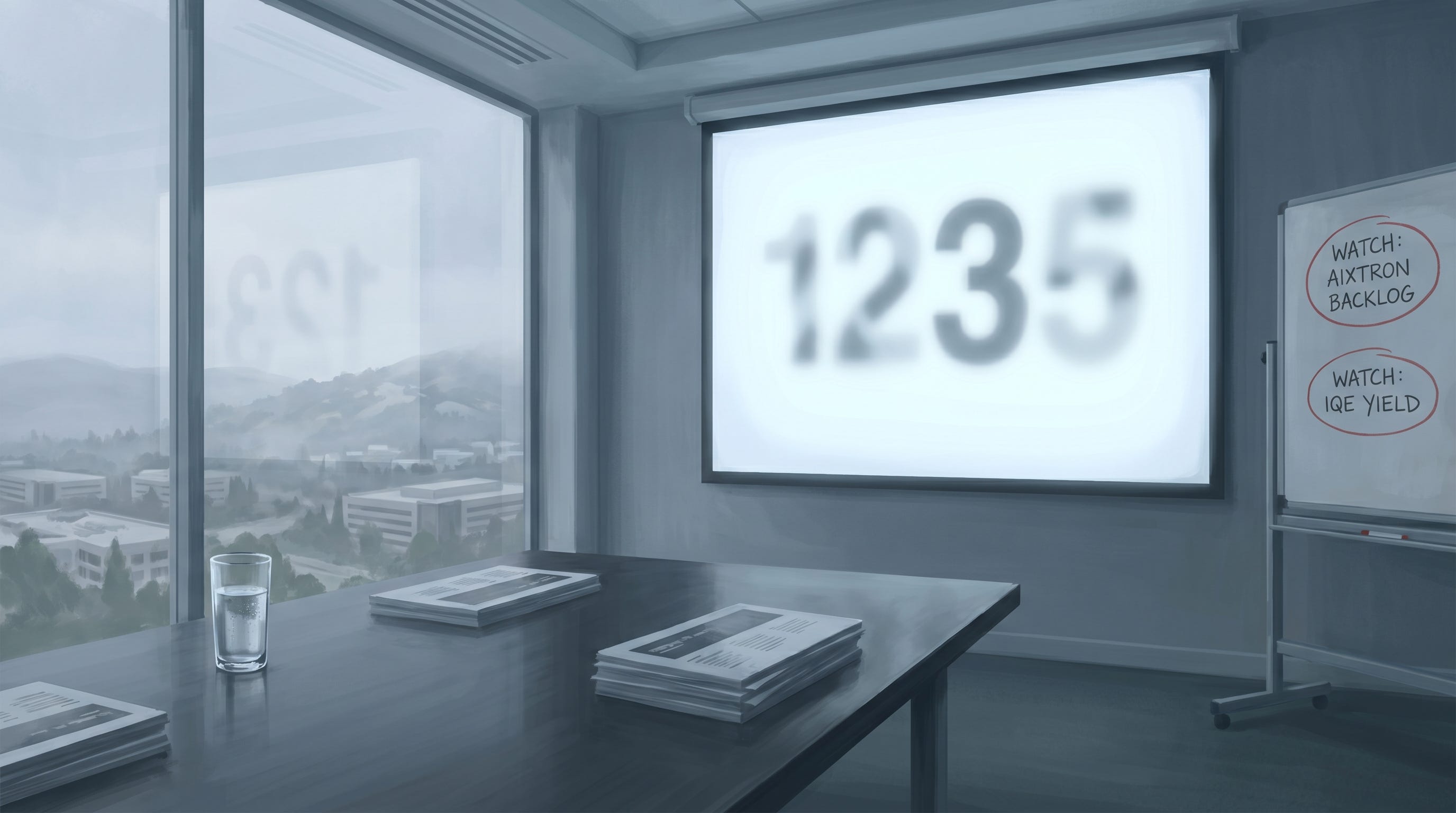
Year 1 — simulation snapshot
Good morning. I've been asked to present a technical briefing on the photonic interconnect transition for this group — fifteen minutes, three numbers, one structural observation, two things to watch. I'll go fast.
First-generation CPO field-failure rate: four hundred and twelve FIT. FIT stands for failures in time — it's the number of failures per billion device-hours. Silicon logic is currently running at approximately one hundred FIT in production. Four hundred and twelve is roughly four times worse. The source is telemetry from four hyperscaler pilot deployments, published on background by three infrastructure engineers across two different companies. The failure modes are three: laser facet degradation above fifty-eight degrees Celsius, fiber-to-chip coupling drift over thermal cycles, and adhesive creep in the optical-mechanical assembly. These are all solvable. None of them are solved yet. Qualification at hyperscaler volume typically requires demonstration of less than one hundred FIT over a six-month field trial. We are currently at four hundred and twelve.
MOCVD reactor backlog at Aixtron: fourteen months. I explained in episode one what MOCVD is. The fourteen-month backlog means that any photonic fab ordering a new reactor today will receive it in fourteen months at the earliest. Sumitomo Electric in Japan and IQE in the UK are confirmed as the only two indium-phosphide wafer fabs qualified to hyperscaler volume specifications. Both are booked through the third quarter of next year. The photonic transition is constrained not by chip design, not by laser physics, not by silicon-photonics process maturity — it is constrained by the throughput of two factories in Japan and the UK and one machine toolmaker in western Germany. This is the supply-chain structure of the most capital-intensive transition in computing history.
China's national photonics program: shelved. The Ministry of Industry and Information Technology announced Thursday that the three-hundred-billion-yuan photonic semiconductor initiative, which had been in planning since twenty twenty-three, will not proceed to funded status in this budget cycle. The stated reason is a reallocation to large-language-model infrastructure. The real reason, per two people close to the program, is that the MOCVD reactor export controls — implemented by Commerce last spring — have made the timeline nonviable. China cannot acquire the growth tools to build the photonic lasers at scale. This is a significant geopolitical development: it means the photonic transition, at least in its first decade, will be led by US, UK, and Japanese supply chains, not a diversified three-bloc structure. The concentration risk that implies is the second thing I want to flag.
The structural observation is this: the DOJ and Commerce are currently running opposite policies on the same two companies. Commerce is treating Broadcom and Marvell's consolidated position in CPO silicon — they've been acquiring market share aggressively since the first hyperscaler qualifications — as a national-security asset to be protected against Chinese displacement. DOJ Antitrust opened a preliminary Section 7 inquiry last week on the same market concentration, HHI above four thousand. These two agencies are going to collide. The resolution will determine whether the photonic transition produces a competitive market or a regulated national-champion duopoly. Watch this.
One: the Aixtron backlog number, updated quarterly. When it shortens, the transition accelerates. When it extends, it slows. It is the single most important leading indicator in this market. Two: the Sumitomo wafer yield data, which will be disclosed in their next quarterly. InP yield at scale is the technical bet the entire supply chain is making. If it misses, the timeline moves right by twelve months minimum.
That is the briefing. Questions offline. Keep your signal clean.
Year 5
Year 5 — simulation snapshot
Good afternoon. I'm Kenji Tanaka, UC Davis, and I want to use my time in this keynote slot to say three things that I think are true and that I don't think are being said loudly enough in these proceedings.
[first: the efficiency paradox] The first thing is about power. Photonic interconnects have delivered on their promise: per-port power is down seventy percent from the twenty twenty-five copper baseline. That is a real engineering achievement and I want to acknowledge it. The problem is that it did not reduce aggregate data-center electricity demand. It enabled more compute density per rack, which enabled more model scale, which enabled more aggregate compute demand, which required forty-seven gigawatts of new gas-peaker capacity to be permitted in the United States in the past eighteen months alone. Diego — my former student at Ayar Labs — calls this the rebound budget. Every watt we saved per port bought two more applications that needed a port. Lena, who manages data-center ops at the Oregon facility, told me last month that they filed for a forty-percent load increase six weeks after their first photonic rack went production. The efficiency gain is real. The conservation outcome did not follow. I want us as a field to stop counting watts per port and start counting watts per query.
The second thing is about market structure. The HHI for co-packaged optics silicon is currently above four thousand two hundred, concentrated primarily in two companies whose combined CPO silicon revenue is growing at sixty percent per year. I know some of you in this room work at or with those companies, so I want to be precise: what I am about to describe is a structural observation, not an allegation. The DOJ opened a Section 7 preliminary inquiry on this market eighteen months ago. That inquiry has not proceeded to a formal investigation. It has not proceeded because Commerce Department has classified the Broadcom-Marvell photonic position as a national-security strategic asset in the context of China's photonics program. What this means in practice is that the same government agency that approved the technology export controls that prevented China from acquiring MOCVD reactors is now citing the competitive advantage produced by those controls as the reason not to apply domestic antitrust. The loop is closed. I don't know how to unclose it. I think this community should be paying attention.
The third thing is about the MOCVD backlog. It is now at thirty-four months at Aixtron and twenty-eight months at Veeco. The combined output of both companies is approximately three hundred and forty reactors per year. The global photonic scale-up requires an estimated five hundred and eighty new reactors in the next four years. We are undersupplied by approximately forty percent, and the manufacturers' production capacity is itself limited by a smaller set of upstream tooling suppliers whose names I will put in the supplemental slides. The photonic transition is not bottlenecked on lasers or waveguides or silicon process nodes. It is bottlenecked on MOCVD reactor throughput in two factories and on the seven upstream component suppliers those factories depend on. I run a podcast called The Signal Path where I explain this to a general audience every week. I should not have to explain it to an IEEE photonics conference. But the supplemental slides suggest I do.
Around the world at Year Five: InP epitaxy has concentrated at sixty-one percent Japan, twenty-two percent UK, fourteen percent US — a geographic structure with geopolitical implications that the photonic community has been slow to acknowledge. The UK and Japan holding forty-three percent of the world's advanced laser substrate production is a strategic fact that does not appear in any of the twenty-five papers published at this conference this week about photonic integration. In Shenzhen, the foundries that had been developing photonic process nodes for the Chinese national program are now running capacity for legacy logic at a loss while their photonic equipment sits idle — a five-year investment stranded by export controls. In Ayar Labs' Santa Clara lab, Diego told me this morning that their current InP wafer yield is at seventy-three percent of target. That is better than twelve months ago. It is not good enough to expand production without risking the supply chain. I'll take questions now.
Year 10
In 2033, a data center opened in Boardman, Oregon that used no copper for any interconnect longer than four millimeters. The facility ran at one-point-two-one power-usage effectiveness — which means it consumed twenty-one cents of cooling and management overhead for every dollar of compute it delivered. The previous best, in twenty twenty-five, was one-point-five-eight. The gap between those two numbers saved an estimated forty-seven terawatt-hours per year across the hyperscaler fleet — roughly the residential electricity consumption of Portugal.
The physical plant was unremarkable from the outside: a long gray rectangle in eastern Oregon, surrounded by transmission lines and an access road. Inside, the fiber ran in tight orange bundles from rack to rack, carrying pulses of light at a hundred and twelve gigabits per second through channels no thicker than a human hair. The copper had been designed out entirely in the build specification. The engineers who wired it were different from the engineers who had wired the previous generation — trained in photonic integration rather than electrical harness routing, hired from programs that had not existed fifteen years earlier.
In Osaka, Jun Tanaka's copper-cable division had shed sixty percent of its volume in the hyperscaler market by twenty thirty-three. The division was still profitable — data centers were still copper below four millimeters, still copper in every non-hyperscaler installation on Earth, still copper in the residential and commercial buildings that represented the majority of cabling by count if not by revenue. But the growth curve was gone. The forward order book ran twelve months. It used to run thirty-six.
The indium-phosphide supply chain was by this point the most geopolitically sensitive compound-semiconductor market in the world. Japan held sixty-one percent. The UK held twenty-two. The United States, which had invested heavily in MOCVD reactor export controls to prevent Chinese photonic advancement, held fourteen percent of the substrate that those reactors were built to process. The irony was legible to anyone who read the export-control filing and the InP market-share chart side by side. The controls worked. They created a supply structure that the US did not control.
The MOCVD backlog had normalized at thirty-four months at Aixtron and twenty-eight at Veeco. The world had reorganized itself around these numbers. Hyperscaler build cycles now had a thirty-month photonic procurement lead time baked into their capital planning. Startups that needed MOCVD time and couldn't wait bought time on equipment owned by the foundries, which charged for it at a rate that reflected the scarcity. The effective capital cost of entering the photonic-integration market was not the chip design or the fab process. It was the reactor queue.
Lena, at the Oregon facility, described managing the transition as the most technically satisfying decade of her career and the most logistically punishing. The equipment was better. The supply chain was harder. She had four PhD photonic engineers on staff who had not existed as a job category when she started in data-center ops. She had lost two legacy electrical engineers who had decided the new stack was not for them. The facility ran on both skill sets, with the new one growing and the old one not being replaced when it left.
Diego, at Ayar Labs, had been promoted twice since the Day One qualification sample. He now ran the hyperscaler customer engineering team. He described the transition as having two phases: the phase where everyone doubted it would work, and the phase where everyone pretended they had always known it would work. The second phase was more politically complicated than the first. In the first phase, the physics determined everything. In the second phase, the market structure was determining most of it.
Year 25
Year 25 — simulation snapshot
I want to start with a question that I've been asked more often than any other over the past twenty-five years of working in photonics. The question is: was this transition as big as people predicted?
And my answer is: yes and no, in exactly the proportions that matter.
Let me start with the yes. The physics worked. Co-packaged optics eliminated the copper bottleneck in large-scale AI clusters, and the elimination was permanent and complete. The energy savings were real — forty-seven terawatt-hours per year by Year Ten, on its way to ninety by today. The per-port cost of photonic interconnects, which was four times the cost of copper in twenty twenty-five, is now roughly sixty percent of copper in applications above fifty gigabits per second. Diego's qualification samples that shipped in twenty twenty-five are the direct ancestors of the hardware running the AI systems that most of you interact with every day. The physics worked, the engineering followed, and the transition was as large as the most optimistic projections predicted on the technical axis.
Now the no. The no is about structure.
The transition produced a hardware monopoly more concentrated than Standard Oil's, hiding inside a national-security classification that has been renewed six times without a single public hearing. A FOIA filed last year by the AP and Reuters revealed that the independent-audit provision of the PIC Consortium charter — the provision that would have allowed non-affiliated parties to verify that photonic foundry capacity was being allocated fairly — was killed in a side meeting in Geneva in twenty thirty-two. The meeting was attended by representatives of TSMC, GlobalFoundries, and a Singapore-based consortium whose three board seats overlap with TSMC-Lightmatter, ASML-Ayar, and the Department of Energy's photonic-computing program. The provision was removed from the charter by consensus, without a vote, without minutes, and without any party outside the meeting being informed for eight years.
The consequence: a nineteen-and-a-half-times lead-time spread between customers affiliated with the consortium and customers not affiliated. Four weeks versus eighteen months. The FOIA revealed this was not a capacity limitation. It was a scheduling policy. The independent auditor who would have caught this was removed before they were appointed.
I want to draw a line between this finding and the MOCVD story, because they are the same story told at two different scales. In twenty twenty-six, I stood at an IEEE photonics conference and told this room that the binding constraint on the photonic transition was thirty-four months of reactor backlog at two companies in Germany and the United States. That was true. What I did not know was that the backlog was being managed, at the output end, to produce exactly the competitive structure that the major foundry customers required. The scarcity was partly physics. The distribution of the scarcity was policy.
My daughter Yumi is twenty-five. She has never worked with copper racks. She takes for granted the infrastructure that this room spent thirty years building. What she is going to spend her career working on — I suspect — is the governance of the infrastructure she inherited. The technical transition was successful. The institutional transition was not complete.
The photonic era arrived. What we are still building is who it belongs to.
Keep your signal clean.
Epilogue
That is the series. Five episodes. Twenty-five years from the first confirmed hyperscaler co-packaged-optics qualification sample to the FOIA that exposed the photonic foundry cartel.
Three things across the arc. One: the constraint was always the tooling, not the physics. The MOCVD reactor backlog at Aixtron determined the pace of the entire photonic transition more than any chip design or algorithm breakthrough. Two: the rebound effect was real. Photonics made each unit of compute cheaper and more energy-efficient, which made the total number of compute units explode, which meant total power draw kept rising. Efficiency is not conservation unless you also cap the application. Three: the 2032 side meeting that killed the independent-audit clause was the most consequential event in the simulation — more consequential than any product launch — because it determined who could access the infrastructure and who could not for the following decade.
Yumi is twenty-five. She has never worked in a data center with copper racks. She does not know what 17 watts per port felt like. That is the infrastructure transition working as intended. Keep your signal clean.
Generated by Ask NOSTRA — a multi-agent AI simulation system that models the ripple effects of speculative scenarios across five time horizons. The events described are simulated projections, not predictions.